The Frame Shop installs perceptual capacity rather than delivering conclusions. Three books, one question at three scales: is our capacity to act real, or only apparent?
Each book stands on its own. Read them in any order.
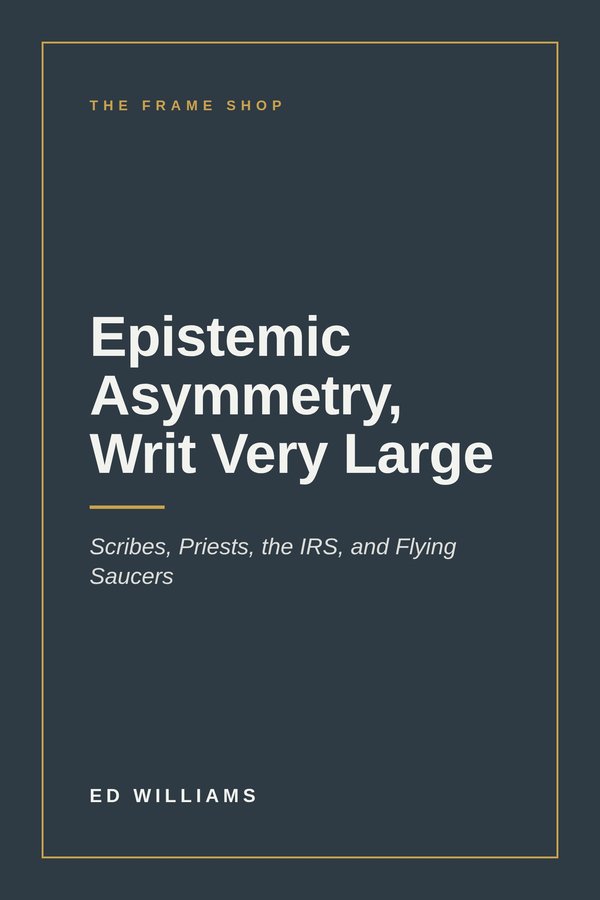
The civilizational volume
Scribes, Priests, the IRS, and Flying Saucers
Every durable knowledge gap produces someone who manages it. A history of who keeps the gaps open, and how to see the structure underneath.
Read more and buy
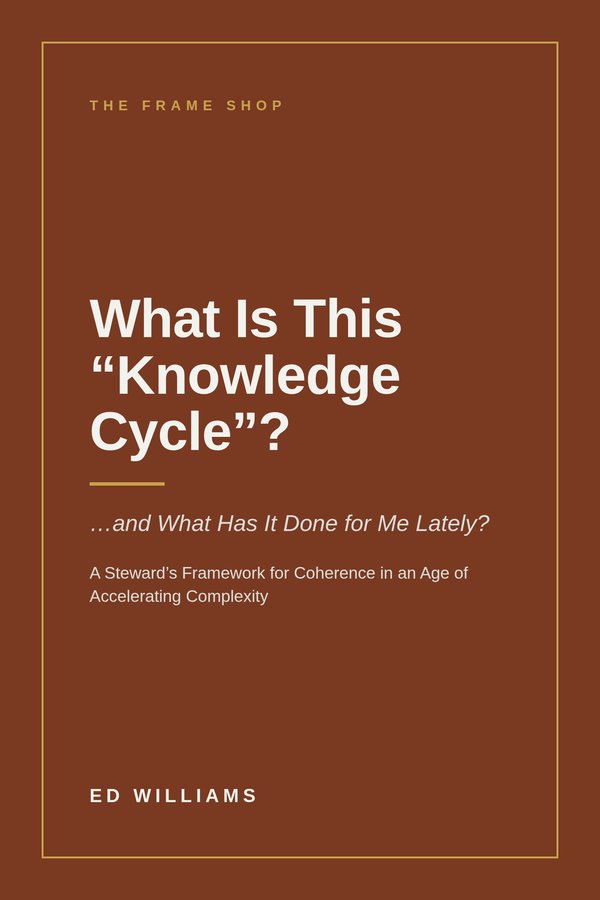
The foundational volume
…and What Has It Done for Me Lately? A Steward’s Framework for Coherence in an Age of Accelerating Complexity
Most difficulty is not a capability problem. It is a perception problem. The foundational framework, and the case for stewardship.
Read more and buy
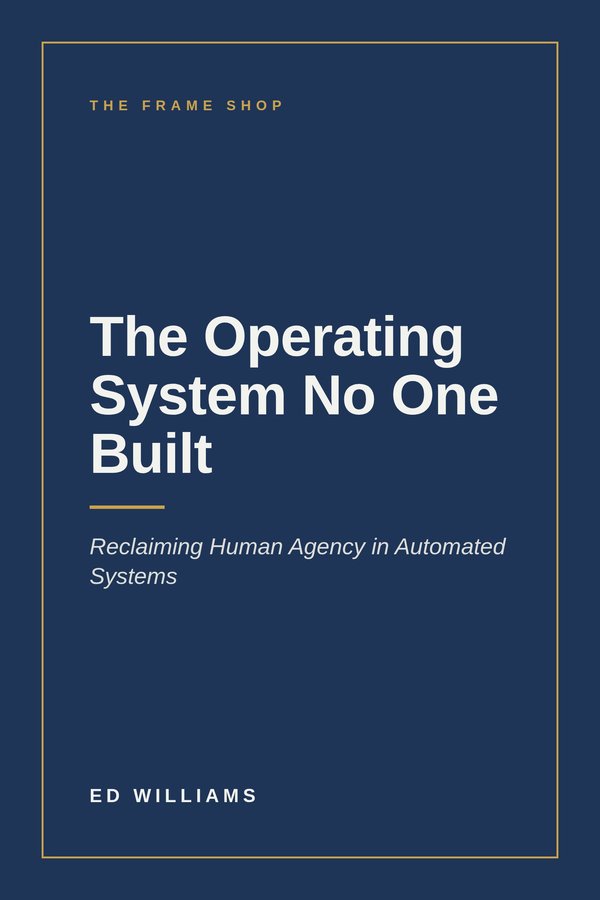
The organizational volume
Reclaiming Human Agency in Automated Systems
When systems start making decisions, authority does not disappear. It drifts. How to keep outcomes owned.
Read more and buyThe complete series, at a set price.
$68.88 all three paperbacks shipped to you, plus all three ebooks now
$17.88 all three ebooks
Who Is Counting Your Grain? and Start Here, a short guide to how the three books fit together.
Ed will send both to you personally. Your address is never sold or shared.

Ed Williams is a practitioner, writer, and teacher based in Salt Lake City, Utah, and the founder of The Frame Shop. His work rests on a single observation: most problems that seem stuck don't need a new solution. They need a new angle.
That conviction comes from three teachers whose influence runs through everything he writes. W. Edwards Deming showed that knowledge is a process, not a possession. R. Buckminster Fuller argued that humanity must derive its operating principles from observed reality rather than inherited authority. Milton H. Erickson's therapeutic reframing located the angle from which a problem dissolves instead of the force needed to overcome it. Williams encountered much of this lineage directly through Burklyn Business School and the Money & You program, which he first attended in 1983.
His career has spanned operations leadership, organizational consulting, and decades of watching how authority and accountability actually work inside organizations, families, and institutions, and how they fail. That experience produced a three-book series built around one question: is our capacity to act real, or only apparent? What Is This "Knowledge Cycle"? lays out the underlying framework. Epistemic Asymmetry, Writ Very Large examines the question in civilizations and institutions. The Operating System No One Built takes it inside organizations that increasingly rely on automated decisions.
Williams teaches this material as a practitioner-led course and works with organizations and business owners facing decisions that effort alone won't solve. His governing test for any system, human or automated, is simple: does it affirm or deny human agency?
Legacy starts today.
For business owners thinking about the handoff: a quiet, structured conversation about everything that has to be settled before you let go. Start with the free twelve-question Snapshot.